Stanford researchers at the Xing Lab have developed a novel method using deep neural networks called "Q
2MRI" to simultaneously acquire qualitative MR image and quantitative MRI parametric maps without changing the clinical imaging protocol or elongating MRI scan time. Currently, quantitative MRIs are obtained from a series of qualitative MRI, which takes prohibitively long scan times. The new method automatically derives quantitative MRI from a single qualitative MRI with an established prediction model. In addition, the proposed approach suppresses measurement errors caused by RF inhomogeneity and eliminates the possibility of inter-scan motion. This invention will enable broader use of quantitative MRIs which provides more information about tissue characterization and tissue response assessment than qualitative MRIs.
Figure 1
Figure 1 description - Generating quantitative T1 map and proton density map from qualitative T1 weighted MRI (a) using conventional model fitting and (b) using a deep convolutional neural network. Figure 2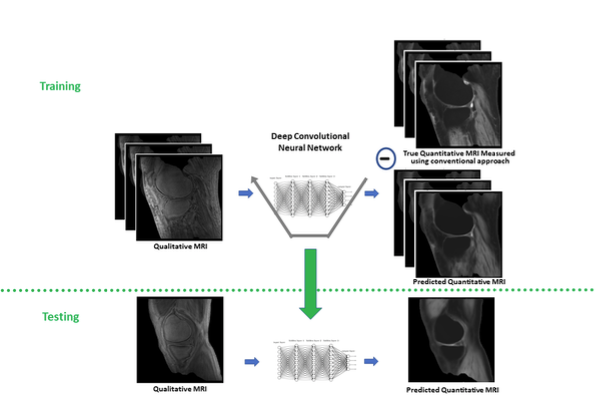
Figure 2 description - Training and testing of a neural network for the derivation of quantitative MRI from a single qualitative MRI. Notice that the ground truth image is obtained using conventional quantitative MRI.Stage of Research:
Completed simulations - (using digital phantoms) derived various quantitative MR maps from a single qualitative MR image
Completed experiments on T1 mapping of cartilage MRI - predicted quantitative T1 map from a single qualitative T1 weighted MR image (that was acquired using a UTE sequence) with B1 inhomogeneity compensated
Continued experiments on T2 mapping